
Character development and relationships
Develop characters through the world that changes them.
A character is not a paragraph of traits. Character becomes visible through pressure: the person they avoid, the place they cannot return to, the object they protect, and the event they remember differently from everyone else.
Create the story categories your book needs
The Story Navigator is not restricted to a fixed list such as Characters, Locations, and Objects. Create and name collections around your own fiction: families, factions, witnesses, planets, magical laws, case files, political offices, or anything else the story treats as important.
Each item opens into its own profile. Keep descriptive notes, imagery, relationships, planning references, and manuscript mentions together so a story element becomes more useful as the book grows.
- Custom collections and colors
- Individual connected profiles
- Reference images and notes
- Planning and manuscript backlinks
Map relationships as specific connections
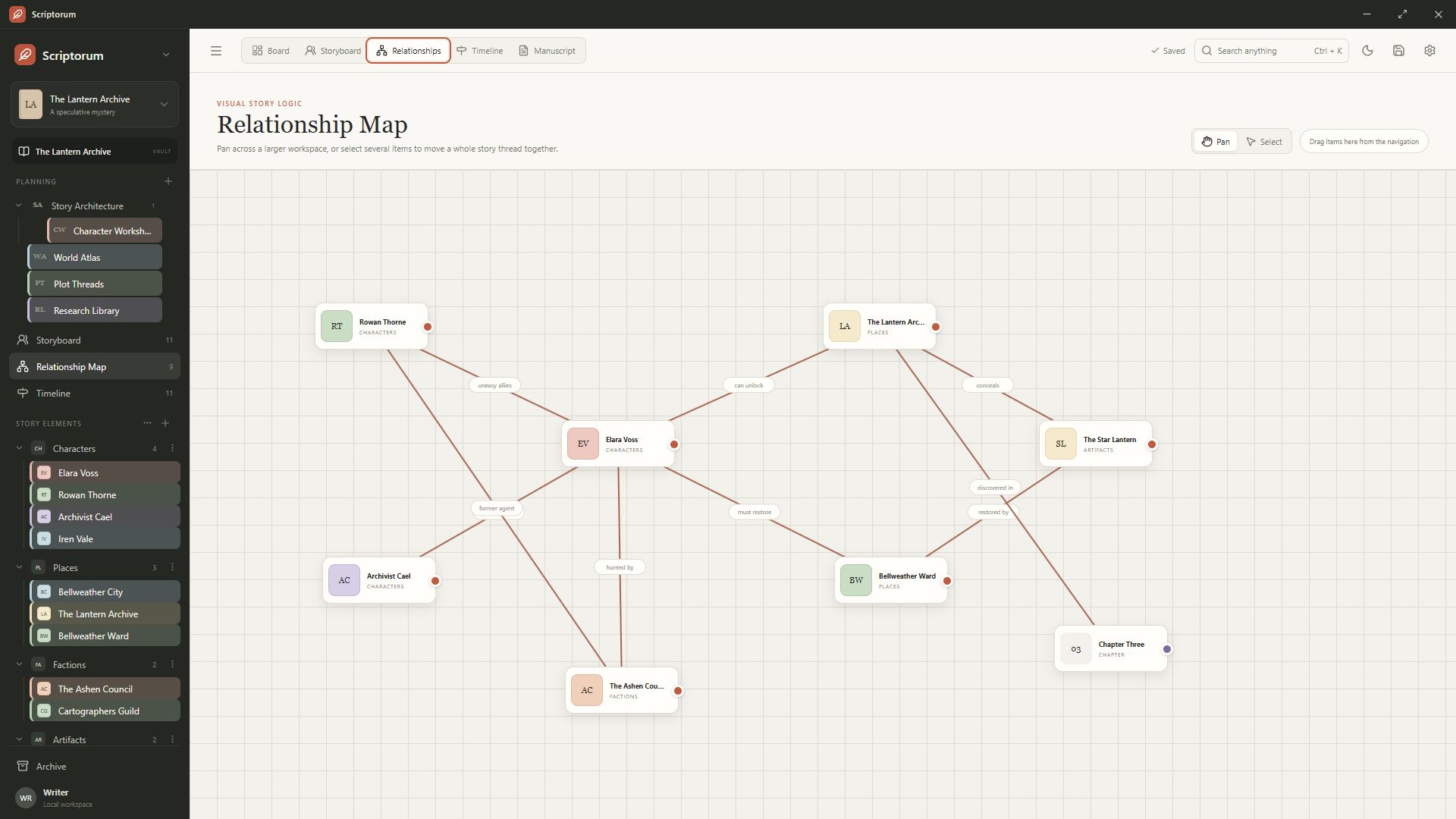
Place story elements on a relationship map and connect the exact items that affect one another. A character can link to a location, an event, an artifact, another character, or any custom category you created.
Relationship labels describe what the line means. The map becomes a view of story logic rather than a decorative family tree, while every node remains linked to the profile it represents.
Use connections while revising
Open a profile to review its direct relationships and follow references back into planning boards or manuscript chapters. This is particularly useful when revising a long book or series, where a small continuity decision may have been made hundreds of pages earlier.
Scriptorum does not generate a character for you. It gives you a durable place to accumulate the evidence that makes a character convincing.
Common questions
What writers usually ask.
Can I create categories besides characters and locations?
Yes. Story collections are intentionally customizable and can represent any category that is meaningful to your project.
Can a character connect to individual locations or events?
Yes. Relationship maps and direct connections operate on individual story elements, not only broad category headings.