
DOCX, PDF, and EPUB export
Finish with a book, not a pile of disconnected chapters.
The document needed by an editor is not the same file needed for a print proof or an ereader. Scriptorum compiles the same ordered manuscript into formats designed for those different stages.
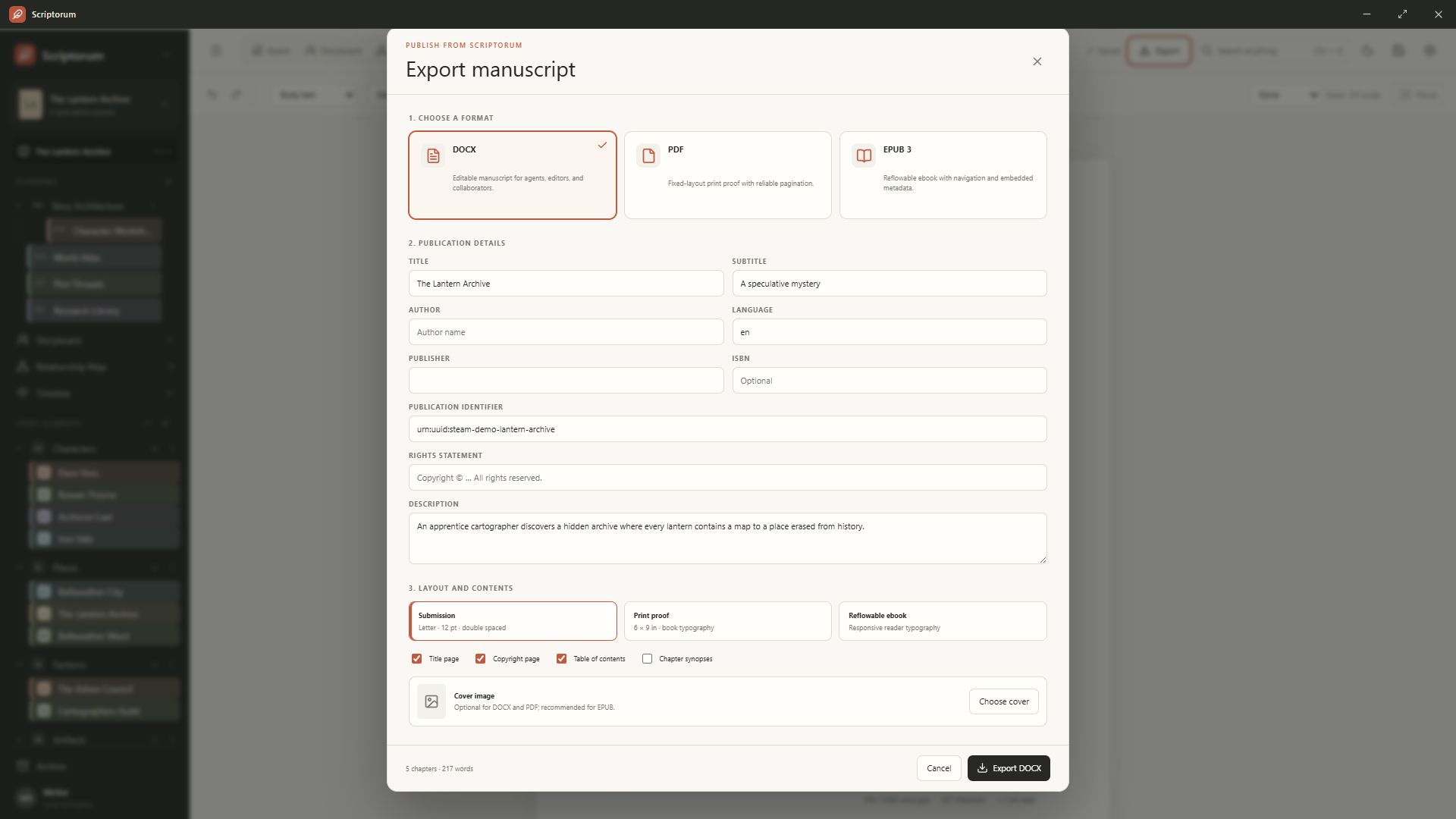
Compile the manuscript once
Choose the ordered chapters and book information that belong in the export. A shared compile model carries chapter structure, front matter, back matter, scene breaks, images, and publication metadata into the selected output.
Useful presets provide starting points for an editable manuscript submission, a print-oriented proof, or a reflowable ebook. The formats share the book's structure without pretending their typography and page behavior are identical.
- Editable DOCX manuscript
- Print-oriented PDF
- Reflowable EPUB 3
- Book metadata and cover information
Create a standards-compliant ebook
EPUB exports include package metadata, navigation, semantic XHTML, compatible styling, and embedded assets. Representative exports are checked against the official W3C EPUBCheck validator under EPUB 3.3 rules.
A reflowable ebook adapts to the reader's device and font preferences. It is not a screenshot of the manuscript page, and Scriptorum treats that distinction as part of the publishing workflow.
Retain an editable handoff
DOCX provides a familiar file for editorial collaboration and later production work. PDF provides a stable visual proof for reviewing page-oriented output. Writers can select the format that belongs to the next step instead of treating export as a single generic download button.
Common questions
What writers usually ask.
Can Scriptorum export an EPUB?
Yes. Scriptorum creates reflowable EPUB 3 ebooks with navigation, metadata, semantic content, and embedded assets.
Can I still edit the book outside Scriptorum?
Yes. DOCX export provides an editable manuscript for collaboration and downstream production.